
Venus Flytraps: A Complete Guide to Care and Cultivation
Venus flytraps (Dionaea muscipula) are native to North Carolina and South Carolina, and here at Quaker Meadows Carnivores, we've been growing them in the western part of NC for many years. While our mountains and foothills are a long way from their coastal plain habitat, we've spent years learning exactly what these plants need to thrive outside their natural range.
The inside of each trap contains six trigger hairs (three on each lobe) that detect prey. The trap snaps shut when two hairs are touched within about 20 seconds, or when one hair is touched twice in quick succession. This safeguard prevents the trap from wasting energy on raindrops and other non-prey stimuli: a fascinating example of plant arithmetic and memory that makes the Venus flytrap truly unique.
Venus flytraps grow naturally in the longleaf pine savannas and Carolina bays of the coastal plains which are open, humid, sunny wetlands with nutrient-poor, acidic soil that many plants can't tolerate. That's exactly why carnivorous plants evolved to eat insects: to compensate for what the soil lacks. In the wild they grow alongside Sarracenia pitcher plants, sundews, and other bog natives. Understanding this habitat is the key to growing them well in cultivation.
The typical Venus flytrap is mostly green but the insides of the traps can develop coral pink to bright red coloring when grown in full sun or under full spectrum grow lights. Many Venus flytrap cultivars exist, such as Red Dragon which produces fully deep maroon-red plants and DC XL which looks like the typical Venus flytrap except it produces unusually large traps.
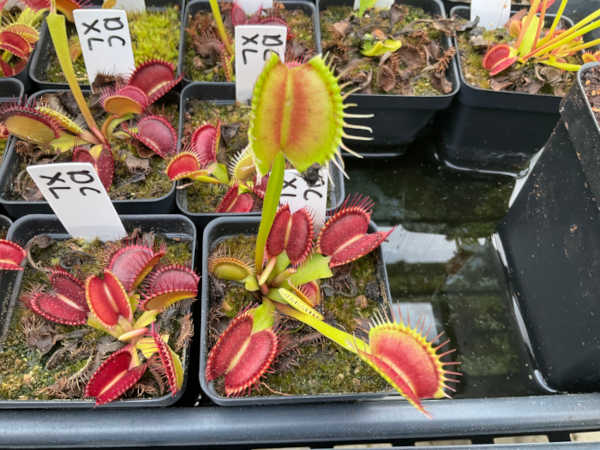
Caring for the Venus flytrap in cultivation is easy.
Soil: A typical carnivorous plant mix of 4:1 peat:perlite can be used. It's fine to increase the perlite ratio if you want; Venus flytraps do appreciate good drainage when grown potted. Long fiber sphagnum moss is also a great growing medium for Venus flytraps and may be preferable to the peat & perlite mix in some growing conditions, such as indoors under lights. Be sure to chop up the sphagnum moss into smaller pieces and do not wrap long strands of sphagnum moss around the plant's roots, as this will prevent the roots from growing properly. When potting a Venus flytrap, be sure the bulb is below the soil surface, not sitting on top.
Water: Venus flytraps need consistently moist to wet soil and should never be allowed to dry out. You can allow the pot to sit in a shallow dish of water to maintain the soil moisture content Venus flytraps need to thrive. While they do need a high soil moisture content to thrive, they are not aquatic plants and care must be taken to avoid growing them in waterlogged conditions. Allow the dish of water to dry between refills and only fill to about 1/4 or less of the pot's height. Use only rain water, distilled water, or very filtered tap water; chlorine is deadly to these plants. A TDS meter is very helpful and the TDS of the water you use with Venus flytraps should be as low as possible. We recommend a ZeroWater pitcher for a small personal collection of Venus flytraps.
Light: Venus flytraps need full sun to thrive. They can be grown outdoors in full sun or indoors under full spectrum lights and need 8 - 10 hours of light per day (up to 12 hours if grown indoors under lights).
Dormancy: Venus flytraps do need a winter dormancy to survive long-term. For those living in the Southern United States, Texas, and the West Coast, Venus flytraps can be grown outdoors year-round. They can tolerate winter temperatures in the mid-20s Fahrenheit for short periods of time (such as a nighttime cold spell) and mature plants growing with some protection (such as on a south-facing concrete patio or near a house wall) can survive even lower temperatures briefly. For those living where winter temperatures are consistently very low (Midwest and Northern United States), you may need to provide a "faux dormancy" by putting your plants in the fridge for 2 - 3 months and then growing them indoors under lights until outdoor temperatures are consistently above 32F. These months of reduced temperature and photoperiod induce the dormancy Venus flytraps need. During this time, the leaves and traps die back and the plant may appear to be dead but growth will resume when temperatures and light increase in the Spring.
Feeding: Venus flytraps grown outdoors will typically catch all the food they need and don't require supplemental feeding. We highly recommend growing your Venus flytrap outdoors for at least some portion of the Spring / Summer months so they can consume a variety of natural insect food. If growing indoors, the traps will need to be fed from time to time. You don't need to feed all of the plant's traps at once; just one of the traps once a week is fine. Venus flytraps can eat many different types of insects and will even eat small slugs and snails (minus the shell). You can catch food for your flytrap pet outdoors or carefully feed it dead flies with tweezers. Each trap is only capable of supporting a limited number of feedings before it dies back, do not be alarmed if this happens.